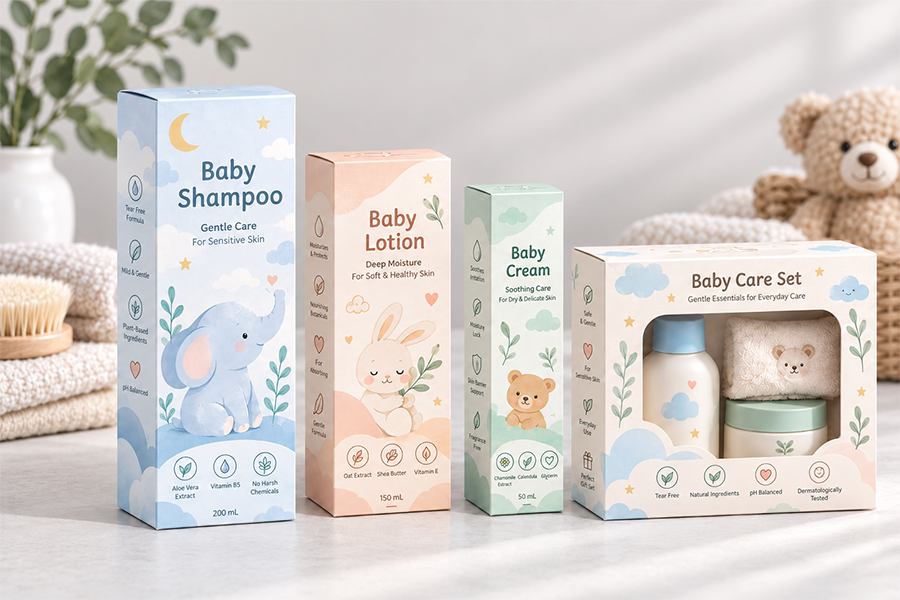
Baby care products need packaging that feels clean, gentle, trustworthy, and easy to understand. Parents and caregivers often compare similar items on the shelf, so the outer box has to communicate the product type, key information, and brand identity without looking crowded.
For baby shampoo, lotion, cream, oil, wash, soap, and small care sets, paper packaging is commonly used as secondary packaging around the bottle, tube, jar, or primary container. The paper box protects the primary pack from rubbing and light handling damage while providing more space for branding, instructions, ingredients, warnings, and other required information.
The best paper packaging box should match the product weight, primary container, retail environment, labeling needs, and opening experience. This guide explains the structures, materials, printing choices, and design details that work best for baby care products.
What Should Baby Care Paper Packaging Do?
Baby care packaging has both a visual and functional role. The carton needs to reassure the buyer while remaining practical during filling, transport, shelf display, and home use.
Clear information is especially important. The front panel should make the product type easy to identify, while side and back panels provide room for directions, ingredients, manufacturer information, warnings, and market-specific labeling.
The structure should fit the primary container closely. Too much empty space allows movement, while an overly tight carton can deform around pumps, caps, and shoulders. Good baby care packaging balances clean presentation, readable information, protection, and efficient material use.
1. Folding Cartons for Baby Shampoo, Lotion, and Cream
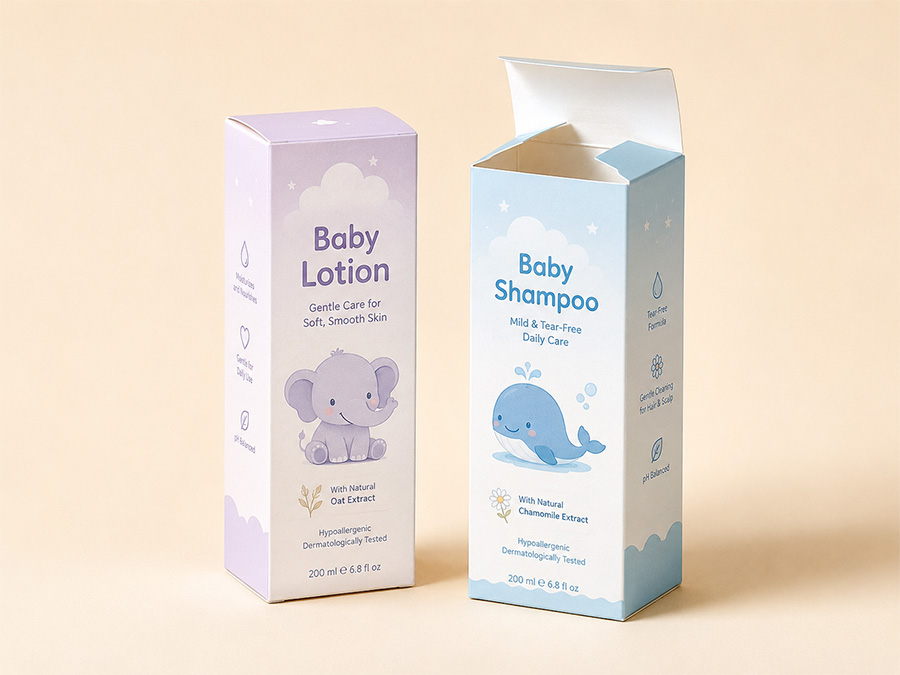
Standard folding cartons are one of the most practical choices for individually packed baby care products. They can be produced in many dimensions and are suitable for bottles, tubes, jars, and small containers.
Straight tuck end and reverse tuck end structures work well when the product is lightweight and the carton needs to be easy to assemble. Their front, back, and side panels provide useful space for soft branding, product descriptions, instructions, and regulatory information.
A well-fitted carton gives the product a cleaner shelf appearance and helps keep the container upright. This structure works best when the primary container already provides most of the physical protection.
For example, a baby cream tube can use a narrow folding carton sized closely around the tube, while a baby shampoo bottle may require a taller carton with enough clearance for the cap.
2. Auto-Lock Bottom Boxes for Heavier Bottles
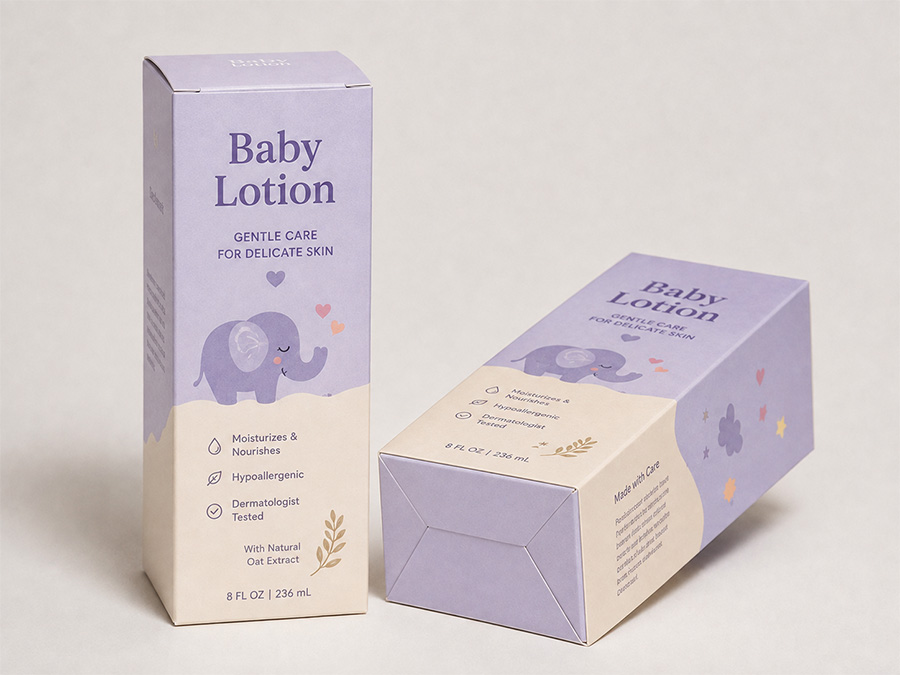
Baby oil, larger lotion bottles, and pump bottles may need more bottom support than a basic tuck carton provides. In these cases, an auto-lock bottom box can be a better option.
The base locks as the carton is opened, creating a stronger bottom for heavier products and making manual packing more efficient.
This structure is most useful when the product weight or filling process justifies the extra support. For pump bottles, the top area also needs enough clearance around the pump or cap, so the dieline should be based on the actual container rather than nominal volume alone.
An auto-lock bottom should not automatically be used for every baby care product. Lightweight tubes and small bottles often do not need the additional structure. Selecting the box according to actual weight helps avoid unnecessary material and production complexity.
3. Window Paper Boxes for Product Visibility
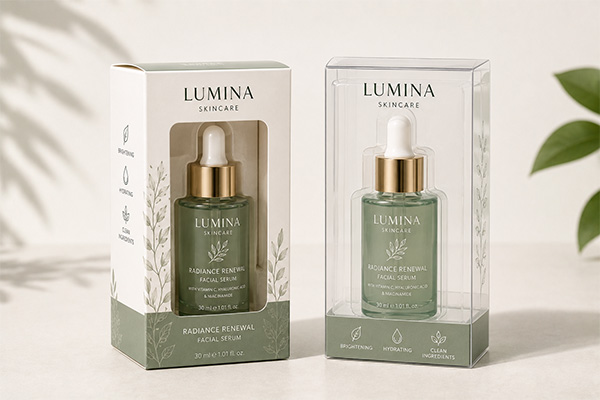
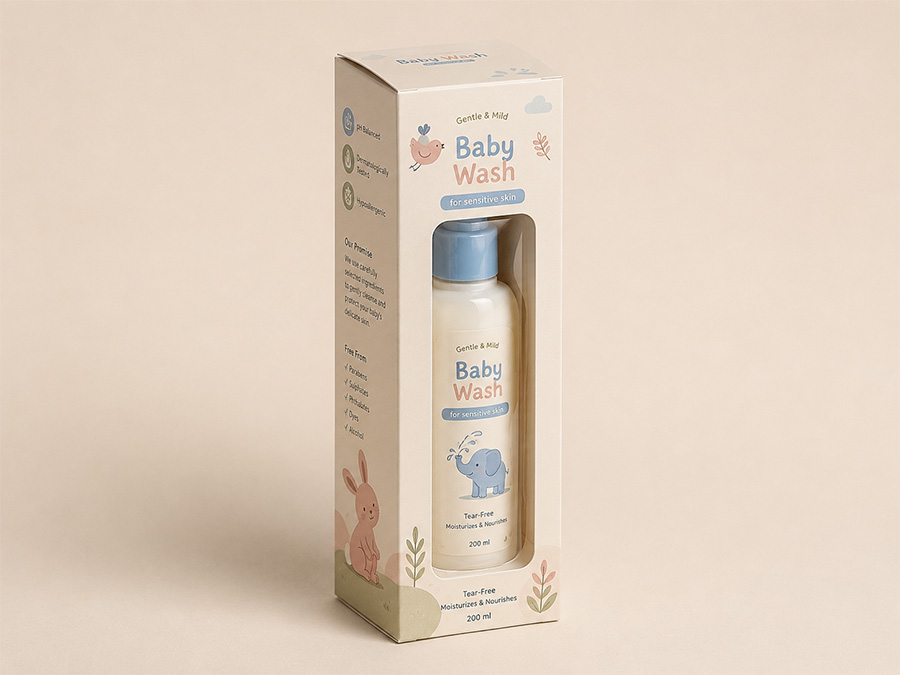
A window box can be useful when the brand wants customers to see the actual bottle, tube, soap, or care item inside. The opening may be left uncovered or fitted with transparent film, depending on the packaging design.
For baby care products, smaller controlled windows often work better than very large cut-outs. A narrow vertical window can show the container color or label while leaving most of the paperboard available for branding and important information.
The window should not remove so much paperboard that the carton becomes weak around corners or folding lines. For heavier bottles, the structure should be tested with the real product before production.
A window is most useful when seeing the container helps customers understand the product. If visibility does not add meaningful value, a fully printed carton can provide more space for product information and a simpler material structure.
4. Paper Boxes with Inserts for Baby Care Sets
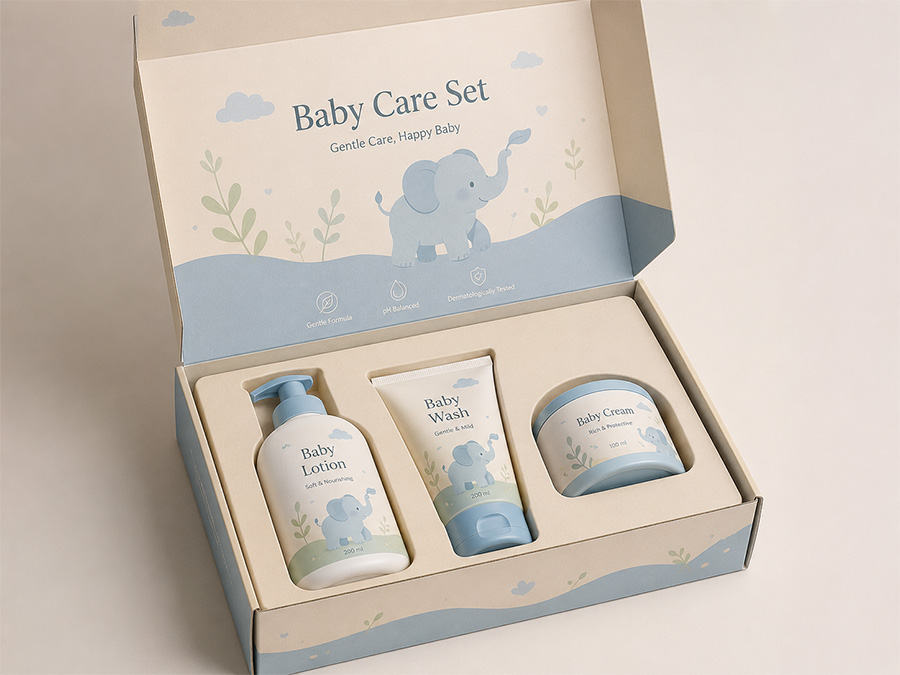
Baby care gift sets and multi-product kits often need more internal organization than a single carton can provide. A paperboard insert can create separate positions for lotion, wash, cream, oil, or other coordinated products.
The insert improves presentation and reduces movement during handling. Accurate dimensions are essential: openings should hold containers securely without making them difficult to remove. Sampling with the actual products is more reliable than designing only from photographs.
The insert should also consider the shape of bottle shoulders, caps, pumps, and tubes. Two products with similar volumes can require completely different openings because their external shapes are different.
For a baby care set containing several containers, the goal is to keep the products neatly aligned while avoiding unnecessary empty space.
Best Paper Materials for Baby Care Packaging
White paperboard is usually the most flexible material for baby care folding cartons. Its smooth surface supports clean printing, soft colors, fine text, and detailed product information. It also works well with matte or gloss lamination, varnish, embossing, and selected foil details.
Kraft paper can suit brands that want a more natural visual direction. However, its brown base changes the appearance of printed colors, especially pale pastels and light tones. Artwork printed on kraft should not be expected to look identical to the same design on white board.
For heavier baby care sets, thicker paperboard or reinforcement may be appropriate. Material selection should reflect product weight, box size, stacking, and shipping conditions.
The paper material should therefore be selected after the product and structure are known, rather than choosing a board only because of its appearance.
Printing and Color Design for Baby Care Products
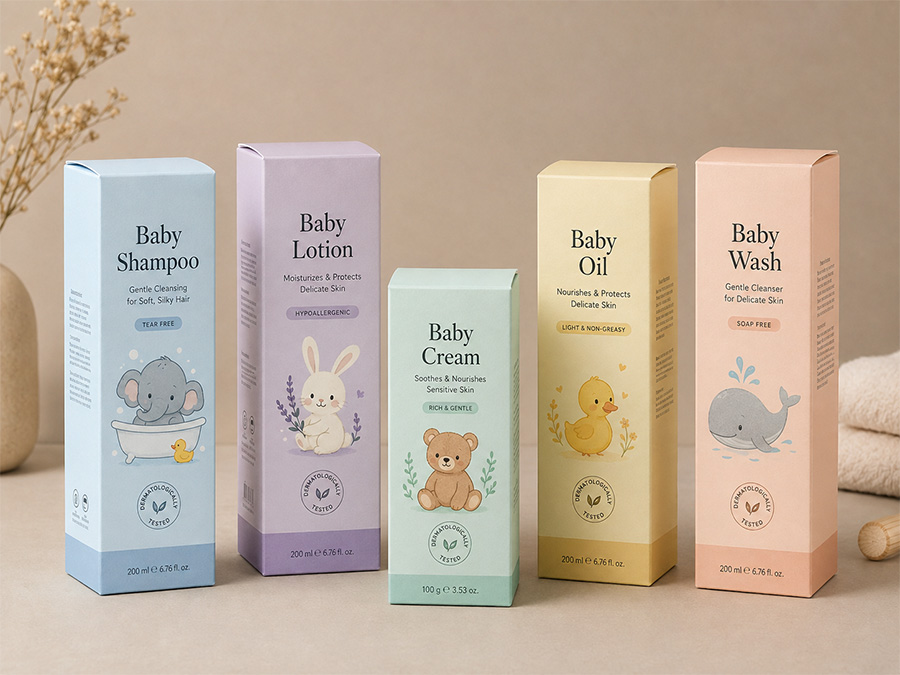
Baby care packaging often benefits from a calm, clear visual system. Soft blues, greens, warm neutrals, pale yellow, lavender, and other gentle tones can work well, but the palette should come from the brand rather than from a fixed “baby” formula.
Readable contrast matters more than using pastel colors everywhere. Very light text on a pale background can make instructions difficult to read. Small ingredient and warning text should remain clear after printing, lamination, and folding.
CMYK printing works well for illustrations, gradients, photographs, and multi-color artwork. Pantone spot colors can be useful when a brand requires tighter control of a signature color.
Matte lamination creates a softer, lower-glare surface, while gloss lamination provides more reflection and can make colors appear stronger. Either can work for baby care packaging when it supports the artwork and retail positioning.
Keep the Design Clear, Not Overdecorated
Baby care packaging needs personality, but too many decorative processes can reduce clarity.
Large foil areas, several typefaces, busy illustrations, oversized windows, and multiple competing finishes may make a box harder to read. A simpler hierarchy usually works better: brand first, product name second, key product information next, and detailed information on the side or back panels.
If foil stamping, embossing, or spot UV is used, it should emphasize a specific element rather than compete with the information parents need to find quickly.
For a product range containing baby shampoo, baby lotion, baby wash, and baby cream, a consistent structure can also make the series easier to recognize. Color changes or small illustration differences can identify each product while preserving the same overall packaging system.
Sustainability Considerations
For brands that want responsibly sourced paper packaging, FSC-certified paper and packaging can support responsible forest sourcing through the FSC certification system.
Material efficiency also matters. A box that is much larger than the product uses more board, occupies more shipping space, and may require extra internal support. Right-sizing the carton is one of the simplest ways to reduce unnecessary material.
Window packaging should be considered carefully when sustainability is a priority because adding transparent film introduces another material. If product visibility is not necessary, a fully printed paper carton may be the simpler option.
How to Choose the Best Paper Box for Baby Care Products
Start with the primary container. Measure the actual bottle, tube, jar, cap, or pump and confirm the total product weight.
Next, decide what the box must accomplish. A lightweight lotion tube may only need a standard folding carton. A heavier pump bottle may benefit from an auto-lock bottom. A product that needs shelf visibility may justify a window, while a multi-item set may require an insert.
Then review the artwork and information requirements. Make sure the carton has enough space for the product name, directions, ingredients, warnings, barcode, and other market-specific information without forcing the text into an unreadably small size.
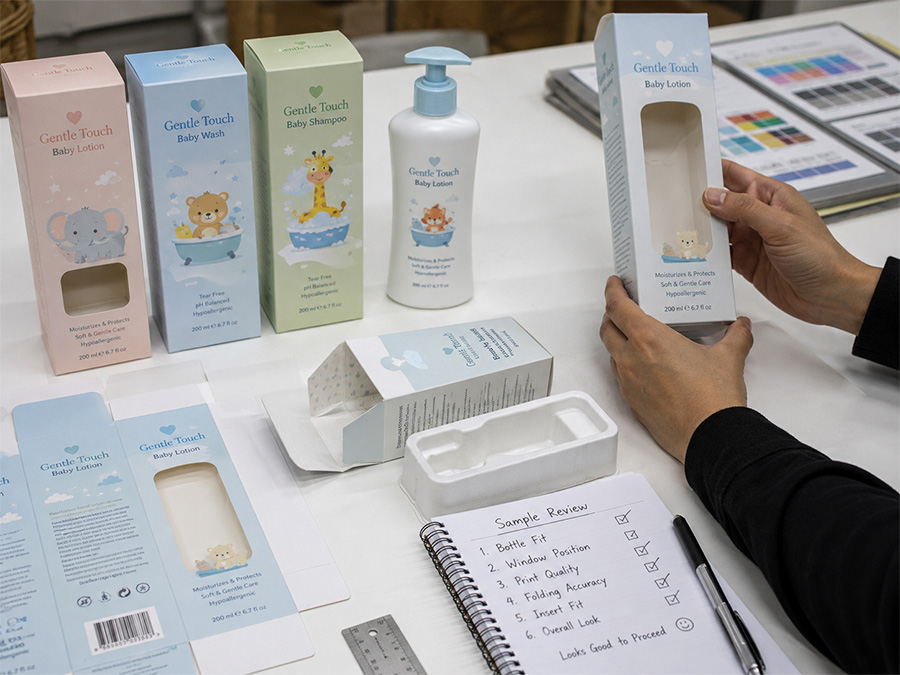
Finally, produce a physical sample. Check product fit, bottom strength, folding, opening, printing, color, insert position, and shelf appearance with the real product inside.
A box that performs well with the actual product is more important than selecting a structure only because it looks attractive in a rendering.
Conclusion
The best paper packaging boxes for baby care products are the ones that match the product rather than follow a single packaging style.
Standard folding cartons work well for many baby shampoos, lotions, creams, and washes. Auto-lock bottoms can provide better support for heavier bottles, while controlled windows improve product visibility. For baby care sets, custom paperboard inserts help organize several products inside one package.
Material, structure, printing, information layout, and product fit should be considered together. Baby care packaging needs enough visual warmth to attract the buyer, but it also needs clear information and practical protection.
Before mass production, brands should confirm the actual container dimensions, product weight, required labeling, artwork, and selling market, then evaluate a physical packaging sample. This approach produces a paper box that is easier to manufacture, easier to understand on shelf, and better suited to the baby care product inside.
Bailipack can customize paper packaging boxes for baby shampoo, lotion, cream, oil, wash, and baby care sets according to the required size, paper material, box structure, printing, finishing, window, and insert configuration.